Thursday, January 14, 2010

Hawaii Volcanoes

Fire Walking With the Lava Junkies

Photographer James Balog in front of a

"We took a helicopter to the rim and hiked about a mile [1.6 kilometers] into the steaming cauldron of Kilauea's Pu'u 'O'o crater to this skylight. Geologists call the skylight the Cookie Monster because it really looks like the shape of the character on Sesame Street."

Plumes of gas escaping from vents as lava meets air

Plumes of gas escaping from vents as lava meets air

From the helicopter, we saw lava splashing and frothing 50 feet [15 meters] below the surface in these 75- to 100-foot-wide [23- to 30-meter-wide] pools.

Lava breaks out of its shell of hardened, black rock

Lava breaks out of its shell of hardened, black rock

This is a breakout, or a live surface flow of molten rock. The magma was oozing under the skin of cooled black rock—it's hotter than hell up there. Eventually a buildup of pressure under a certain place will crack the surface over it, and the lava will break out.

The Highcastle lava bench (new land that is formed as lava cools)

The Highcastle lava bench (new land that is formed as lava cools)

This was our final quest—the ocean entry at Highcastle, the holy grail for lava photographers. The lava was coming over the last cliff before entering the ocean.

A lava breakout from newly cooled rock

A lava breakout from newly cooled rock

If I stepped on the gray rock in this photo, it would feel like stepping into a fire. You can pass over it if you move really quickly. You just dance along.

Lava spiraling down a slope

Lava spiraling down a slope

This is wild. As the drops break out down the slope, the pressure moving the lava, pushing on the cooling skin above it, twists the skin into ropes. This is classic pahoehoe lava. Even where I was standing, the temperature underfoot was a few hundred degrees [approximately 150°C] at least, and there are radiant rocks above me.

The deceptive calm of an extremely hot flow

The deceptive calm of an extremely hot flow

This shot may look like a dreamy day on the side of a volcano, but it was really wicked. I am standing downwind of an a'a flow, which is notorious for emitting an exceptional amount of radiant heat. It was really, truly ferociously hot.

Monday, January 11, 2010

Top 10 Transparent Animals!

  1. Transparent Frog
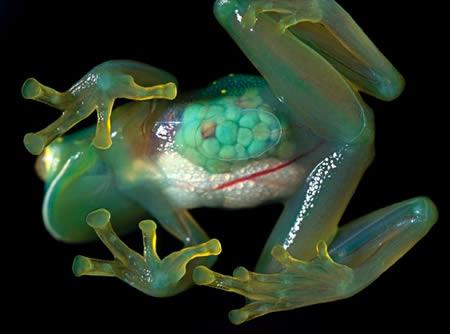
    Transparent Frog
    Native to Venezuela, the Glass Frogs belong to the amphibian family Centrolenidae (order Anura). While the general background coloration of most glass frogs is primarily lime green, the abdominal skin of some members of this family is transparent, so that the heart, liver, and digestive tract are visible through their translucent skin. (Photo by Heidi and Hans-Jurgen Koch)
  2. Transparent Head Fish
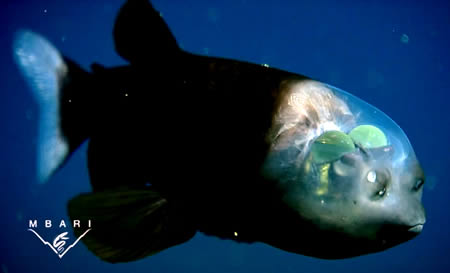
    Transparent Head Fish
    This bizarre deep-water fish called the Barreleye (Macropinna microstoma) has a transparent head and tubular eyes. It has extremely light-sensitive eyes that can rotate within his transparent, fluid-filled shield on its head, while the fish's tubular eyes, well inside the head, are capped by bright green lenses. The eyes point upward (as shown here) when the fish is looking for food overhead. They point forward when the fish is feeding. The two spots above the fish's mouth are not eyes: those are olfactory organs called nares, which are analogous to human nostrils. (Photo by MBARI)
  3. Transparent Butterfly
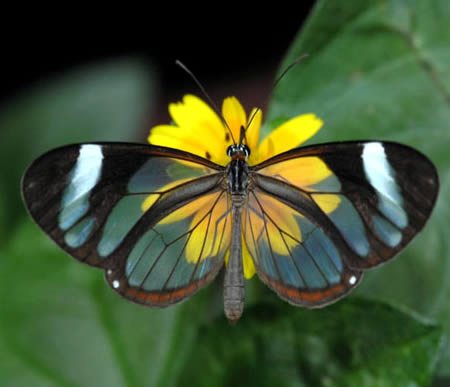
    Transparent Butterfly
    Found in Central America, from Mexico to Panama, the Glasswing Butterfly (Greta Oto) is a brush-footed butterfly where its wings are transparent. The tissue between the veins of its wings looks like glass. (Photo by Hemmy)
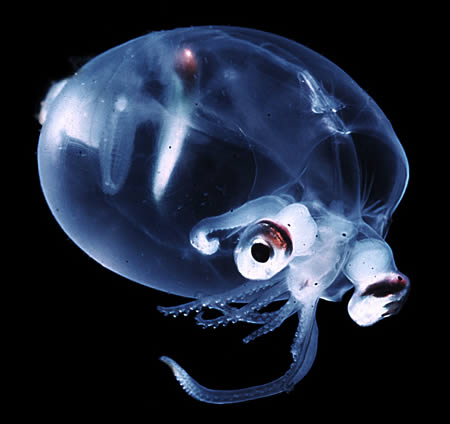
  4. Transparent Squid
    Transparent Squid
    Found on the southern hemisphere's oceans, the Glass Squid (Teuthowenia pellucida) has light organs on its eyes and possesses the ability to roll into a ball, like an aquatic hedgehog. It is prey of many deep-sea fish (eg goblin sharks) as well as whales and oceanic seabirds. (Photo by Peter Batson)
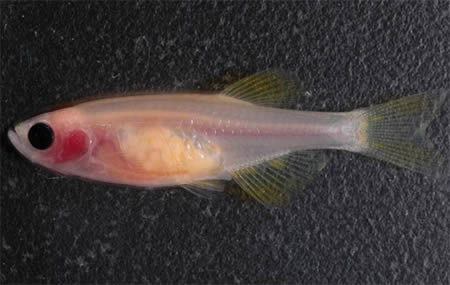
  5. Transparent Zebrafish created by scientists
    Transparent Zebrafish created by scientists
    This see-through zebrafish was created in 2008 by scientists so they can study disease processes, including the spread of cancer. The transparent fish are allowing researchers at Children's Hospital Boston to directly view fish's internal organs and observe processes such as tumor growth in real-time in living organisms. (Photo by LS)
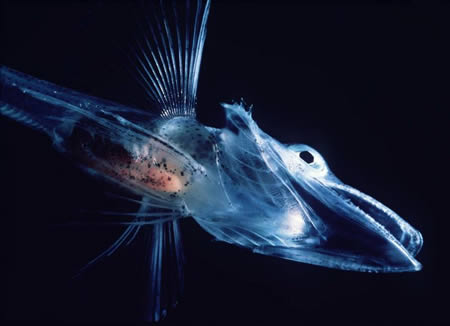
  6. Transparent Icefish
    Transparent Icefish
    Fund in the cold waters around Antarctica and southern South America, the crocodile icefish (Channichthyidae) feed on krill, copepods, and other fish. Their blood is transparent because they have no hemoglobin and/or only defunct erythrocytes. Their metabolism relies only on the oxygen dissolved in the liquid blood, which is believed to be absorbed directly through the skin from the water. This works because water can dissolve the most oxygen when it is coldest. In five species, the gene for myoglobin in the muscles has also vanished, leaving them with white instead of pink hearts. (Photo by uwe kils)
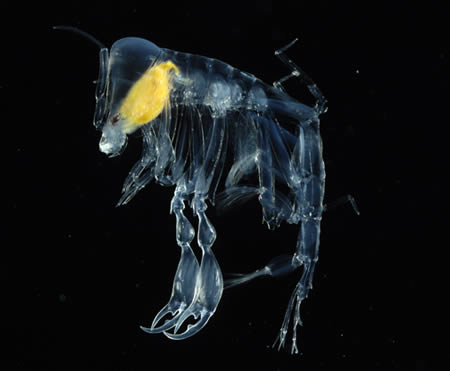
  7. Transparent Amphipod
    Transparent Amphipod
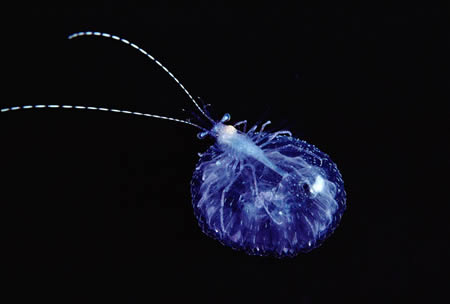
    Called Phronima, this unusual animal is one of the many strange species recently found on an expedition to a deep-sea mountain range in the North Atlantic. In an ironic strategy for survival, this tiny shrimplike creature shows everything it has, inside and out, in an attempt to disappear. Many other small deep-sea creatures are transparent as well, or nearly so, to better camouflage themselves in their murky surroundings, scientists say. (Photo by David Shale)
  8. Transparent Larval Shrimp
    Transparent Larval Shrimp
    Found in the in the waters around Hawaii, this transparent larval shrimp piggybacks on an equally see-through jellyfish. (Photo by Chris Newbert/Minden Pictures)
  9. Transparent Salp
    Transparent Salp
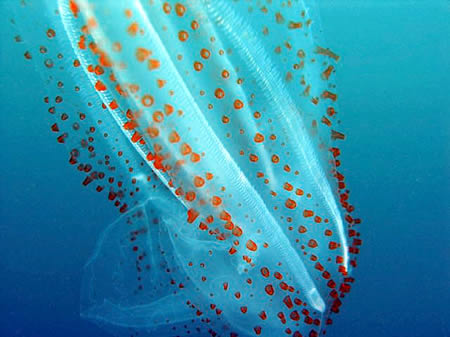
    This jellyfish-like animals known as Salps feed on small plants in the water called phytoplankton (marine algae). They are transparent, barrel-shaped animals that can range from one to 10cm in length. (Photo by DM)
  10. Transparent Jellyfish
    Transparent Jellyfish
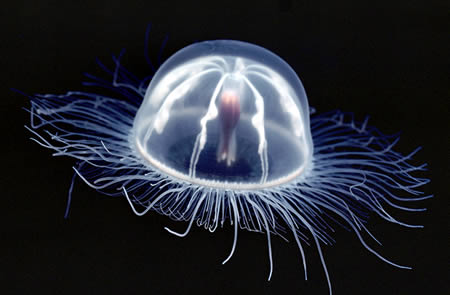
    Jellyfish are free-swimming members of the phylum Cnidaria. They are found in every ocean, from the surface to the deep sea. Many jellies are so transparent that they are almost impossible to see. The one above is from the Arctapodema genus, with a size of an inch-long (2.5-centimeter-long). (Photo by Bill Curtsinger)

Astounding Japanese Highways, Bridges & Interchanges

Astounding Japanese Highways, Bridges & Interchanges

Japan saw most of its infrastructure bombed back to the stone age in the final years of World War II, which makes the country's post-war rejuvenation all the more astounding. Huge, complex public works projects saw a concrete & steel web of highways, bridges and interchanges blossom from the wreckage of war.
Today, shaped by the demands of restrictive space and economic boom & bust, Japan's hardened transportation arteries display artistic forms that go far beyond their functions.

Astounding Japanese Highways, Bridges & Interchanges


(images credit: Ken Ohyama)
Above left is the Hakozaki Junction, part of the Metropolitan Expressway in Tokyo, and at right is the Hokko Junction in Osaka... These images illustrate the solution engineers used when building multi-lane highway interchanges in some of the world's most crowded cities in Japan: go vertical!


(images credit: Ken Ohyama)
Ken Ohyama has made it his mission to chronicle some of the more striking Japanese roadworks in a Flickr series called Interchange and a book of his photos available from Amazon. One of the more outstanding examples is The Hokko Junction shown above - a part of the Hanshin Expressway near Japan's second city, Osaka.

Also in Osaka is the Higashiosaka (East Osaka) Loop of the Hanshin Expressway. The photographer's technique gives the sweeping curve of the roadway an almost tubular appearance:

(images credit: Ken Ohyama)
When engineers have space to work with, they take full advantage. This wide field view of the Higashiosaka interchange shows the almost organic complexity of a busy cloverleaf, resembling a living creature's circulatory system with the vehicles acting as blood cells.

(image credit: zvkk)
Highways upon highways... without any end in sight:

(images credit: Andrew Yamaguchi, Sergei Mingazhev, Stassia)
One interesting feature of Japanese elevated highways: they often run above rivers or sea channels, using the available space above the water. Here are some of these "highways on the sea" -


(images credit: takasuuuui, kokix)
The incredible Japanese road infrastructure really took off in the 1960s - check out the vintage photo on the right:

(left image credit: FotoOleg)
Such "Bladerunner" sights are commonplace now, brimming with urban energy -


(images credit: kokix)
By the way, for the tricky "urban density" photography, head over to this page... and see if you can spot something wrong with the image there.
Slipping Sideways
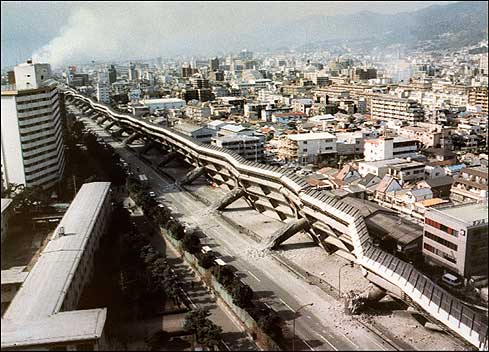
Some sections of the Hanshin Expressway suffered severe damage during the 7.2 magnitude Great Hanshin Earthquake which hit the Kobe, Japan area in January of 1995, killing over 5,500 people and costing over $200 billion.

(image credit: AFP / Jiji Press)
On the bright side, the affected sections of the highway did not "pancake", as happened in the 1989 Loma Prieta quake, but instead slipped sideways and tumbled over. Either way, one doesn't want to be driving through a highway interchange or junction when a big quake hits!
Recession, what recession?
Public works spending has long been the Japanese government's preferred way to spend budget surpluses, boost employment, keep the ruling party's supporters in the construction industry loyal, or all of the above. The highway depicted below is one of those projects, steadily overtaking a quiet city street like Godzilla in slow motion.

(images credit: Cisco's Japan Blog and Snegura)
Which came first, the highway or the building? The question is moot as both have learned to accommodate one another. The Hanshin Expressway takes a shortcut through the 5th to 7th floors of Fukushima's Gate Tower building, also known as the Bee Hive.


(images via)
The story goes that the original building's owner wanted to knock it down and rebuild, but was told by city planners that the space was being allocated to a newly planned exit of the expressway. Both sides refused to budge, and the compromise was completed in 1992.

(image via)
Tokyo residents can easily avoid using the highways and expressways which crisscross the city, thanks to one of the world's largest and most efficient subway systems, but when traffic is light they can be a pleasure to drive. The view can be pretty intense, as in the time-lapse photo below:

(image credit: Vladimir Zakharov)
Urban density in Tokyo is simply astounding:

(image credit: Sam Graf)
The Rainbow Bridge and the longest suspension bridge
Dark Roasted Blend has been covering some rather fascinating bridges before. Here are a few more - a spectacular sample from Japan. The 570 meter (1,870 ft) long Rainbow Bridge spans the northern (inner) part of Tokyo Bay and has been a city landmark since it opened in 1993. Two roadways, a transit line and pedestrian walkways all use the bridge, resulting in a seemingly chaotic tangle from certain angles.


(images credit: Uncharted Futures and lmkuzya)
It's at night, however, that the Rainbow Bridge comes alive with signature color! Spotlights mounted at strategic locations bathe the bridge's superstructure in prismatic glory. Best of all, the lighting is solar powered with energy stored during the day powering the light show at night:

(image credit: Gussisaurio)
Announced in 1969, the massive Kobe-Naruto highway route project stretches 81 kilometers to connect Japan's main island of Honshu with the much smaller island of Shikoku to the south. The jewel in the crown is the 4-kilometer long Akashi Kaikyo Bridge, which cost $3.6 billion to build over the ten year period between 1988 and 1998:

(image credit: Aurelio Asiain)
Of course, any discussion of Japanese highways wouldn't be complete without mention of Mount Fuji. The mountain's iconic snowy peak is visible from Tokyo - on clear days, at least - but though it's certainly possible to reach the dormant volcano's doorstep via highway, taking the Shinkansen bullet train is a better bet.

(image credit: fui)

Sunday, January 10, 2010

BomB Finder__Rat


Staff at Porfell Wildlife Park and Sanctuary near Liskeard, Cornwall, have been teaching Gambian poached rat Kofi to alert handlers when he detects a mine.

Kofi is too small to set off the booby-traps but his acute sense of smell can pick up the scent of the bomb casing.


Rats have been trained in Africa to hunt for land mines but Kofi is the first to undergo the program in Britain.

Handler Wendy Winstanley now plans to contact the Army and the police anti-terror unit to offer her rats' services for use both home and abroad.

She said: "Kofi is amazing, his sniff ability is really incredible. People think of rats as vermin but they are highly intelligent creatures.

"They have a more heightened sense of smell than dogs and because they are so much lighter they have less chance of setting off an explosive.

"Obviously we don't have land mines in this country but I'm so happy with his development that I would be happy to send him to the Gambia if he was required.

"In this country these rats would be excellent at sniffing out bombs. If the anti-terror police wanted me to I would interested and more than happy to train them."

The bomb sniffing training process begins when rats are five weeks old and are weaned from their mothers.

Trainers begin socialising the young rats to the sights, sounds, and textures of the world by walking them on wet grass, going for a ride in a lorry and interacting with humans.

Then the sniffer rats are taught to recognise the smell of metal land mine casings in return for a food reward.

Thirty sniffer rats are already being used in Mozambique, Africa, and have proved incredibly successful for the detection and removal of land mines.

The rodents are fitted to a leash before scrambling their way over a piece of ground, sniffing out any explosives.

A trained rat can clear 100 metres square in 30 minutes, equivalent to two days work for a manual de-miner.

The rats are about 75 cm long (30 inches) and weigh about 1.35 kilograms (3 lbs) which means they can scamper across a minefield without detonating the charges.

7 Unique Natural Phenomena

Here are 7 Unique natural phenomena that you have probably never seen before! From Morocco's tree climing goats to honduras's rain of fishes, Kerala's red rain and many more!

7 Astounding Natural Phenomena

Morocco's Climbing Goats

Natural Phenomena

Natural Phenomena

Natural Phenomena

Natural Phenomena

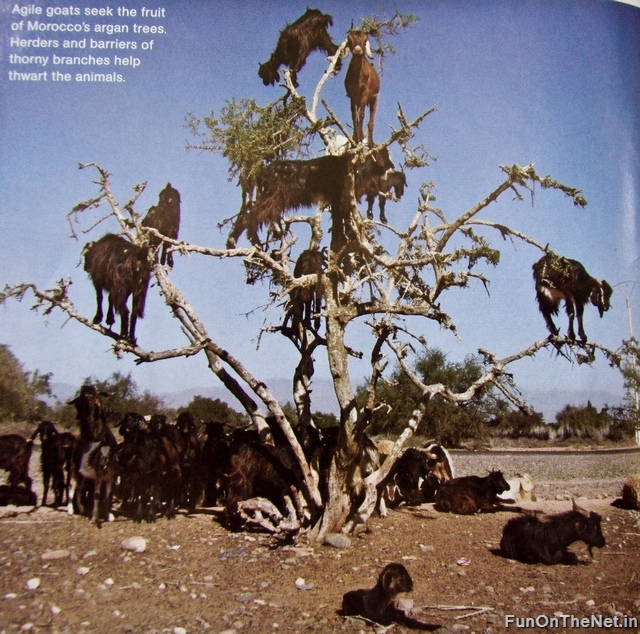
Goats on trees are found mostly only in Morocco. The goats climb them because they like to eat the fruit of the argan tree, which is similar to an olive. Farmers actually follow the herds of goats as they move from tree to tree. Not because it is so strange to see goats in trees and the farmers like to point and stare, but because the fruit of the tree has a nut inside, which the goats can't digest, so they spit it up or excrete it which the farmers collect. The nut contains 1-3 kernels, which can be ground to make argan oil used in cooking and cosmetics. This oil has been collected by the people of the region for hundreds of years, but like many wild and useful things these days, the argan tree is slowly disappearing due to over-harvesting for the tree's wood and overgrazing by goats.
Venezuela's Everlasting Storm

Natural Phenomena

The mysterious "Relámpago del Catatumbo" (Catatumbo lightning) is a unique natural phenomenon in the world. Located on the mouth of the Catatumbo river at Lake Maracaibo (Venezuela), the phenomenon is a cloud-to-cloud lightning that forms a voltage arc more than five kilometre high during 140 to 160 nights a year, 10 hours a night, and as many as 280 times an hour. This almost permanent storm occurs over the marshlands where the Catatumbo River feeds into Lake Maracaibo and it is considered the greatest single generator of ozone in the planet, judging from the intensity of the cloud-to-cloud discharge and great frequency.
Honduras' Rain of Fishes

Natural Phenomena

The Rain of Fish is common in Honduran Folklore. It occurs in the Departamento de Yoro, between the months of May and July. Witnesses of this phenomenon state that it begins with a dark cloud in the sky followed by lightning, thunder, strong winds and heavy rain for 2 to 3 hours. Once the rain has stopped, hundreds of living fish are found on the ground. People take the fish home to cook and eat them. Since 1998 a festival known as "Festival de la Lluvia de Peces" (Rain of Fish Festival) is celebrated every year in the city of Yoro, Departamento de Yoro, Honduras.
Kerala's (extraterrestrial?) Red Rain

Natural Phenomena

From 25 July to 23 September 2001, red rain sporadically fell on the southern Indian state of Kerala. Heavy downpours occurred in which the rain was coloured red, staining clothes with an appearance similar to that of blood. Yellow, green, and black rain was also reported.
Brazilian's longest wave on the Earth

Natural Phenomena

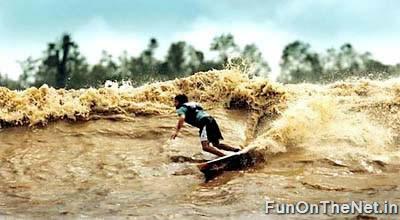
Twice a year, between the months of February and March, the Atlantic Ocean waters roll up the Amazon river, in Brazil, generating the longest wave on the Earth. The phenomenon, known as the Pororoca, is caused by the tides of the Atlantic Ocean wich meet the mouth of the river. This tidal bore generates waves up to 12 feet high which can last for over half an hour.
Natural Phenomena

Natural Phenomena

The wave has become popular with surfers. Since 1999, an annual championship has been held in São Domingos do Capim. However, surfing the Pororoca is especially dangerous, as the water contains a significant amount of debris from the margins of the river (often, entire trees). The record that we could find for surfing the longest distance on the Pororoca was set by Picuruta Salazar, a brazilian surfer who, in 2003, managed to ride the wave for 37 minutes and travel 12.5 kilometers. A surfer's dream: riding an almost never-ending wave.
Denmark's Black Sun

Natural Phenomena

During spring in Denmark, at approximately one half an hour before sunset, flocks of more than a million European starlings (sturnus vulgaris) gather from all corners to join in the incredible formations shown above. This phenomenon is called Black Sun (in Denmark), and can be witnessed in early spring throughout the marshlands of western Denmark, from March through to the middle of April. The starlings migrate from the south and spend the day in the meadows gathering food, sleeping in the reeds during the night.
Idaho's Fire Rainbow
Natural Phenomena

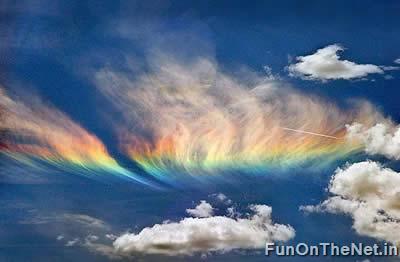
The atmospheric phenomenon known as a circumhorizon(tal) arc, or "Fire rainbow", appears when the sun is high in the sky (i.e., higher than 58° above the horizon), and its light passes through diaphanous, high-altitude cirrus clouds made up of hexagonal plate crystals. Sunlight entering the crystals' vertical side faces and leaving through their bottom faces is refracted (as through a prism) and separated into an array of visible colors. When the plate crystals in cirrus clouds are aligned optimally (i.e., with their faces parallel to the ground), the resulting display is a brilliant spectrum of colors reminiscent of a rainbow. The example shown above was captured on camera as it hung for about an hour across a several-hundred square mile area of sky above northern Idaho (near the Washington border) on 3 June 2006.